State Advisory Group
The Michigan Overdose Fatality Review State Advisory Group (SAG) was established in 2022 to assist with standardizing OFR processes and procedures in Michigan, moving forward recommendations developed at local OFR team meetings, and supporting policy and practice changes at the local, state, and national levels. The SAG is responsible for supporting the MiOFR program through the following core functions:
SAG Responsibilities
Identify best practices, trends, and common themes to inform MiOFR and local OFR practices and policy.
Review local level OFR team recommendations to identify themes and opportunities for improvement. Share findings with relevant parties to influence practice and policy at the local, state, and national level.
Provide member agency updates to increase awareness of ongoing developments and initiatives. Identify intersections with other member agencies and promote collaboration to enhance developments and initiatives.
Develop strategies to assist local OFR teams in reducing barriers experienced in conducting OFR and implementing change.
SAG Membership
SAG membership includes a diverse range of partners committed to improving outcomes across systems impacted by substance use and behavioral health including:
- Public Health: Community, Data, Research, Policy, and Maternal Health sectors
- Medical Examiner
- Law Enforcement
- Hospital Representative
- Parent Advisory Council
- Behavioral Health
- Pharmacist
- HIDTA Representative
- Child Protective Services
- Emergency Medical Services
- Treatment Providers
- Substance Use Disorder Prevention
- Harm Reduction Representative
- Person with Lived Experience
- Others, as needed
Public Health and Safety Team Toolkit Framework
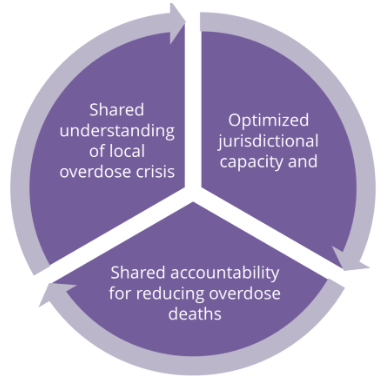
The SAG utilizes the Centers for Disease Control and Prevention’s Public Health and Safety Team (PHAST) Toolkit framework (URL: https://phast.org/) to help local jurisdictions reduce overdose deaths by utilizing data and increasing collaboration and coordination among all sectors, with a focus on public and public safety agencies. The SAG aligns their work with the three primary goals of the PHAST toolkit. The “SOS” goals represent the specific objectives of a PHAST’s data sharing and collaboration activities.
Additionally, the SAG has integrated key action steps from the PHAST modules into its ongoing efforts to support local OFR teams and the MiOFR program. These modules offer a comprehensive framework of practices and strategies that equip both the SAG and local jurisdictions to better coordinate their efforts in reducing overdose deaths.
Case Review Themes
Building on the PHAST framework, the SAG launched a statewide initiative to standardize case selection through the development of Case Review Themes (CRTs). Each year, the MiOFR SAG is charged with analyzing state-level data related to substance use disorders (SUD) and overdose fatalities to develop standardized CRTs for local OFR teams. These data-informed themes provide clear criteria to guide case selection, helping local OFR teams minimize bias and ensure that reviews reflect broader trends. This collaborative framework allows for the pooling of diverse perspectives and resources, enabling a more comprehensive understanding of systemic issues and informing policy and practice improvements at the local, state, and national levels.
The SAG finalized the following CRT priorities for the 2026 calendar year:
Decedents in one, or more, of the following demographic categories:
- Black, Indigenous, and People of Color (BIPOC), with an emphasis on Black males
- 55 years of age or older at the time of death
- Pregnant or had given birth within the 12 months preceding death
- Persons with minor children
Decedents in one, or both, of the following situational categories:
- Incarcerated within the 6 months preceding death
- Experienced, or were perceived to have experienced, housing instability or homelessness
The CRTs are shared with local OFR teams each year as a reference to guide case selection. While the SAG encourages teams to consider the themes, it is important to note local OFR team participation is entirely optional. Local OFR teams have the autonomy to determine which cases to review.
To support statewide learning and collaboration, MiOFR tracks and compiles recommendations from cases that align with the CRTs. These recommendations are shared with the SAG on a bi-annual basis, creating a valuable feedback loop. During this time, the SAG engages in a collaborative problem-solving process to better understand the recommendations, identify recurring patterns and statewide trends, and identify action-oriented priorities for future SAG work. Through this collaborative and data-driven process, MiOFR is positioned to achieve a broader, more unified impact in reducing overdose deaths across Michigan.